
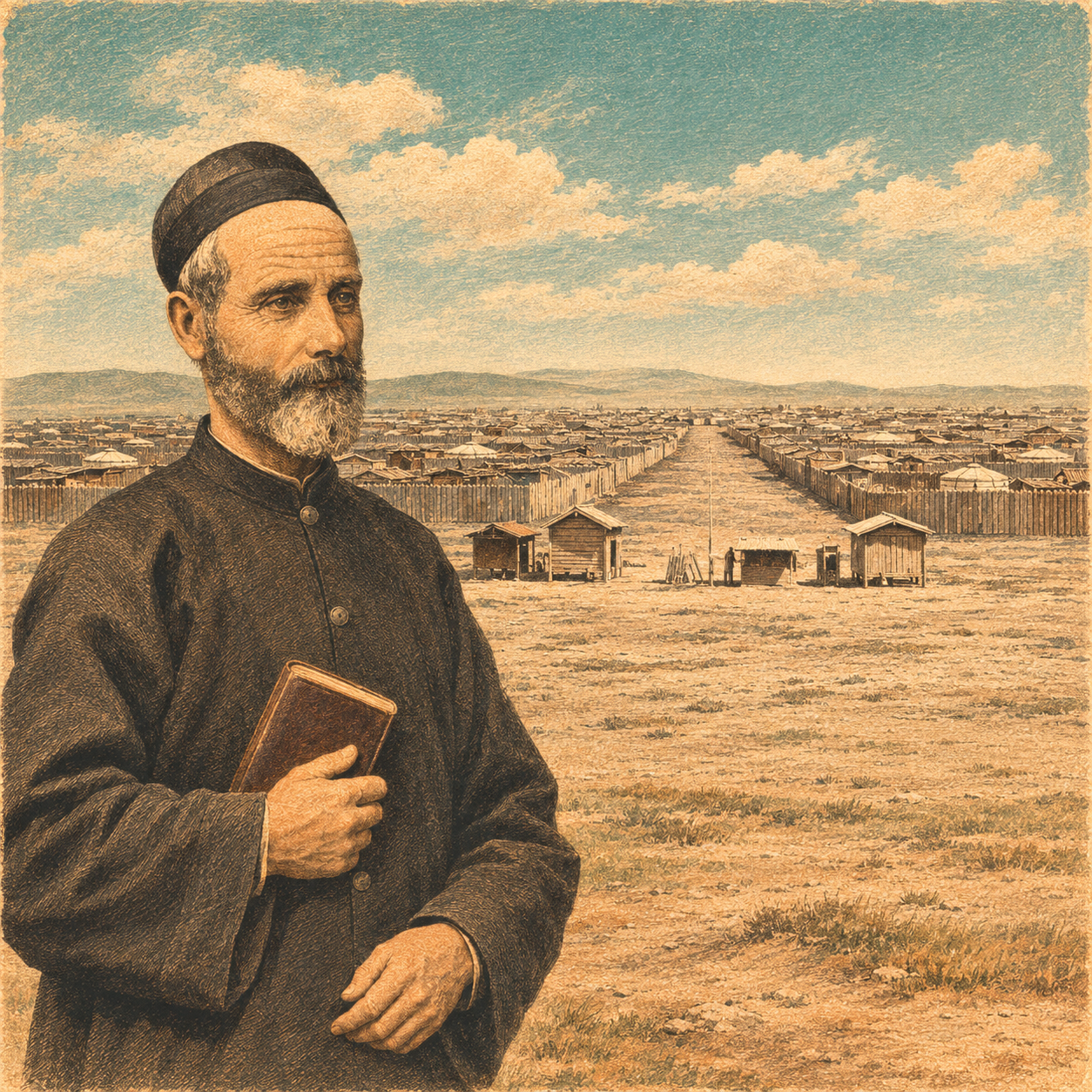
James Gilmour entered the Mongolian world as a learner before becoming a preacher. The Scottish missionary studied at Glasgow and Cheshunt, then prepared for overseas service with the London Missionary Society. He left Britain in February 1870, traveled through Suez and Asian ports, and reached Peking that May.
From Peking he traveled through Kalgan and across the Mongolian plateau, visiting Urga, now Ulaanbaatar, on his way to Kiachta at the Russian frontier. His caravan included a Russian postmaster returning home with his family and Mongol drivers responsible for the camels and carts. Crossing the desert took about a month.
At Kiachta, Russian and Chinese officials would not recognize his passport. While he awaited replacement papers, a Scottish trader named Grant found him lodging. The enforced pause made learning Mongolian an urgent task.
Language learning depended on Mongolian hospitality. When lessons near Kiachta disappointed him, Gilmour moved into tent life, listening to conversations and meeting visitors. In 1871 he stayed with Mahabul and his family. That October, he recorded telling the parable of the prodigal son in colloquial Mongolian to listeners in another tent. The household and its visitors had become a classroom.
Acceptance could disappear unexpectedly. Gilmour recalled camping with his wife beside a large temple, where patients and visitors filled their tent throughout the day. After treating them, the couple took short evening rides. Rumors spread that they were searching for treasure after dark; a messenger speaking for the authorities and ruling lamas ordered them to leave. A harmless recreation had acquired a meaning they had not anticipated.
His medical work brought opportunities for conversation, but also limits. Large queues sometimes left little time for teaching. Returning visits helped patients understand which illnesses he could actually treat. To reassure a frightened patient, he sometimes swallowed a dose himself. He also used illustrated Scripture scenes to explain Christian teaching to groups gathered around his traveling tent.
The fruit was modest and honestly recorded: in his 1883 book, Gilmour reported no Mongol converts yet, but many opportunities to explain salvation and build friendship through treatment. His later eastern ministry took him among agricultural Mongols in territory now within China; his story crosses today’s national boundaries.
Mongolia today has a small Christian minority. Pew’s published research estimates Christians at 1.3 percent of the total population in 2020. Separately, Joshua Project estimates 2.3 percent Christian adherents and 1.3 percent evangelicals.
References
[1] Richard Lovett, editor, James Gilmour of Mongolia His Diaries Letters and Reports (London: Religious Tract Society, third edition, 1895).
[2] James Gilmour, Among the Mongols (London: Religious Tract Society, 1883), printed p. 5 (caravan).
[3] Pew Research Center, Religious Diversity Around the World (12 February 2026),
[4] Joshua Project, Mongolia country profile MG, accessed 9 November 2026.
Artwork references
Nikolai Charushin, City of Urga, 1888, Museum of Ethnography, Budapest, F 14259. Reproduced as photograph 11 in Tímea Bata, Far from Kyakhta and Urga Photographs by Nikolai Charushin in the Museum of Ethnography’s collection related to Jenő Zichy’s expeditions, Tabula Online 24(2) (2023), PDF p. 11; inventory entry PDF p. 24; DOI 10.54742/tabula.2023.2.02.
James Gilmour portrait, frontispiece of Lovett’s 1895 biography, based on a photograph taken at Tientsin in April 1891, as dated in that edition’s list of illustrations. Engraving retrieved and inspected through Project Gutenberg.

