
James & Clara Hepburn: Medicine, Language and the Gospel in Japan
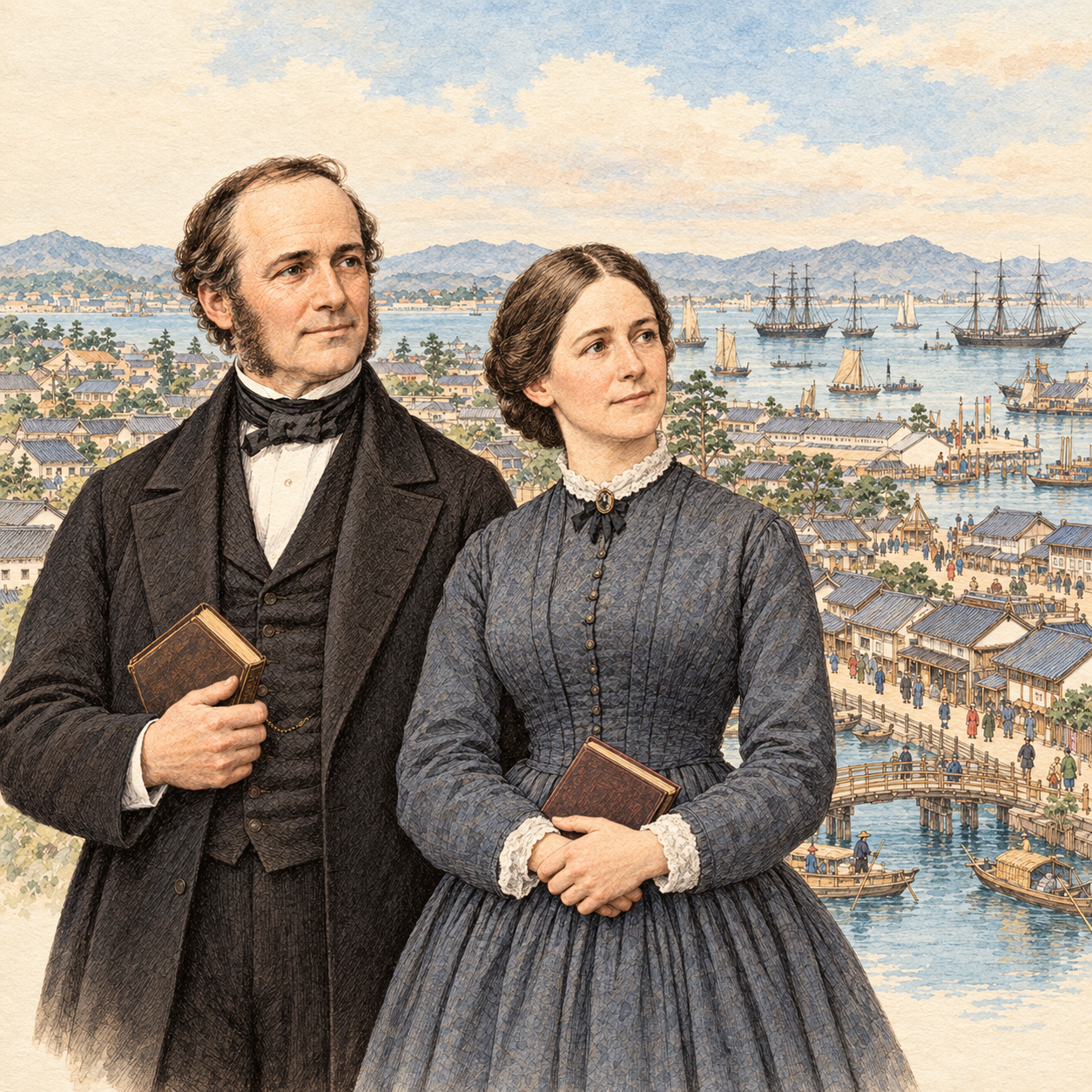
When James Curtis Hepburn and his wife Clara reached Japan in October 1859, Christian mission required patience. They settled at Jobutsu Temple (a former Dutch Consulate facility) in Kanagawa. Medical care, language study, and teaching became ways of building relationships in an unfamiliar society.[1]
Hepburn was born in Milton, Pennsylvania, and trained at Princeton and the University of Pennsylvania, receiving his medical degree in 1836. Earlier missionary service had taken the couple to China. They returned to America in 1845 because of Clara’s poor health, before accepting another overseas assignment.[1]
In Japan, Hepburn offered free treatment. When an early clinic was ordered to close, he concentrated on learning Japanese. A later clinic in Yokohama and Clara’s English academy provided fresh opportunities for service. His Japanese and English dictionary appeared in 1867; he subsequently worked with other missionaries on Scripture translation, including the Old Testament completed in 1887.[1]
Their journey had included a stay in Shanghai, where illness delayed them before their arrival at Kanagawa on 18 October 1859. Years later, Hepburn returned to Shanghai to oversee the printing of his dictionary at the Presbyterian Mission Press.[3] Japanese collaborators were essential: Kishida Ginkō helped compile the dictionary,[6] while the scholar and former samurai Okuno assisted Scripture translation.[3]
Clara’s hospitality became especially tangible after a tragedy on a steamer between Tokyo and Yokohama. Griffis records that a young Presbyterian missionary and his wife died, while their infant and Japanese nurse were thrown into the water and rescued. The child survived with scalds. The Hepburns took him in, and Clara cared for him until he was sent to America.[3] Clara also began a girls’ school in 1863 after a Japanese physician asked her to educate his granddaughter.[3]
The Hepburns’ ministry also nurtured church life. Yokohama’s Shiloh congregation began meeting in Hepburn’s dispensary. He later raised funds for its church building, dedicated in January 1892. By then, the congregation numbered about 300 members under Japanese pastor Hidetaro Yamamoto.[3]
Japan today has a small Christian minority. Pew’s 2024 report, based on its 2023 adult survey, found 46 percent Buddhist and 42 percent with no religion.[2] Separately, Joshua Project’s country profile estimates 1.9 percent of people are Christian and 0.4 percent are evangelicals.[5]
Pray for Japan's churches and frontline ministry workers, who serve in church-planting, discipleship, and through marketplace endeavors.
References
[1] Takaya Michio, “Hepburn, James Curtis,” in A Dictionary of Asian Christianity, edited by Scott W. Sunquist (Grand Rapids: Eerdmans, 2001). https://www.bdcconline.net/en/stories/hepburn-james-curtis
[2] Pew Research Center, Religion and Spirituality in East Asian Societies (17 June 2024), chapter 1. Survey conducted June to September 2023. https://www.pewresearch.org/religion/2024/06/17/religious-landscape-and-change-in-east-asia/
[3] William Elliot Griffis, Hepburn of Japan and His Wife and Helpmates A Life Story of Toil for Christ (Philadelphia: Westminster Press, 1913), chapter IX, printed pp. 77–78 (arrival), chapter XIII, p. 130 (dictionary printing), chapter XII, pp. 113–114 (girls’ school and rescued infant), chapter XI, p. 102 (unnamed teacher), chapter XVII, pp. 168–172 (Okuno), chapter XIX, pp. 183–184 (Shiloh congregation), and chapter XV, p. 154 (translation completion). https://www.electricscotland.com/WEBCLANS/htol/hepburnofjapan00grif.pdf
[4] Agency for Cultural Affairs, Japan, Number of Religious Juridical Persons, as of 31 December 2024. Christian totals: 326 under ministerial jurisdiction plus 4,538 under prefectural jurisdiction. https://www.bunka.go.jp/english/policy/religious_institutions/index-blank.html
[5] Joshua Project, country profile (JA), accessed 13 October 2026, headline Christian Adherent and Evangelical estimates. https://joshuaproject.net/countries/JA .
[6] Hideo Watanabe, “Western Contributors to the Modernization of Meiji Japan: Hepburn and Verbeck,” printed p. 51, section on the dictionary. https://asian.fiu.edu/jsr/watanabe-hepburn-verbeck.pdf
Artwork reference
Background informed by Utagawa Sadahide, Panoramic view of Yokohama, 1861, colour woodblock, National Gallery of Victoria, Melbourne, accession 2016.705. https://www.ngv.vic.gov.au/explore/collection/work/118994/. Artistic impressions of James and Clara Hepburn’s likenesses, not documentary portraits.
